
Fear in trading is normal, because money is at stake. It becomes a problem when fear starts making the decisions: you skip a valid setup, close a winner after a few pips or move a stop away from price. The fix is rarely to be braver. It is usually to reduce the size until a loss no longer scares you, and to add structure so that rules, not feelings, decide what you do.
How fear shows up in trading
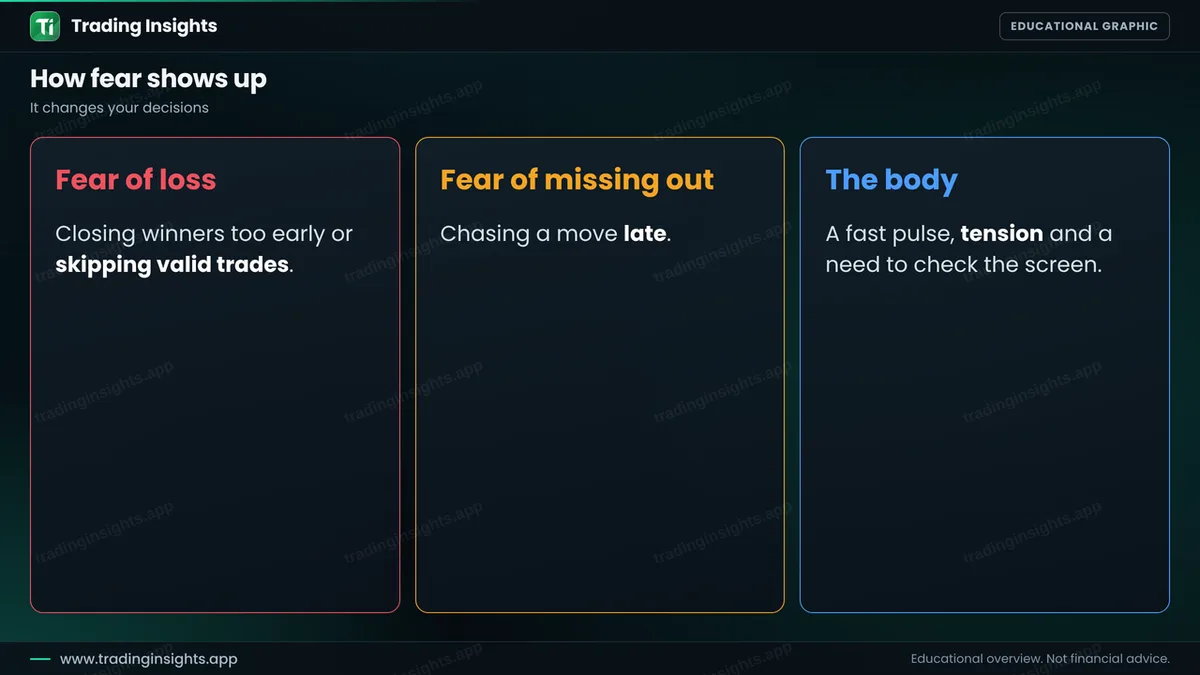
Fear of loss leads to closing winners too early and avoiding the next setup after a losing run. Fear of missing out leads to chasing moves late. Fear can also push you toward revenge trading, when you try to win a loss back quickly. The body reacts as well: tight shoulders, a fast heartbeat, staring at the screen, checking the position every few seconds.
Losses tend to feel larger than wins of the same size, which is one reason fear is so common. Psychologists call this loss aversion. A $50 loss often stings more than a $50 win pleases, so a trader tends to cut winners quickly to lock in the pleasant feeling and let losers run to avoid the painful one. That is the opposite of what a profitable plan needs.
Why too much size makes fear worse
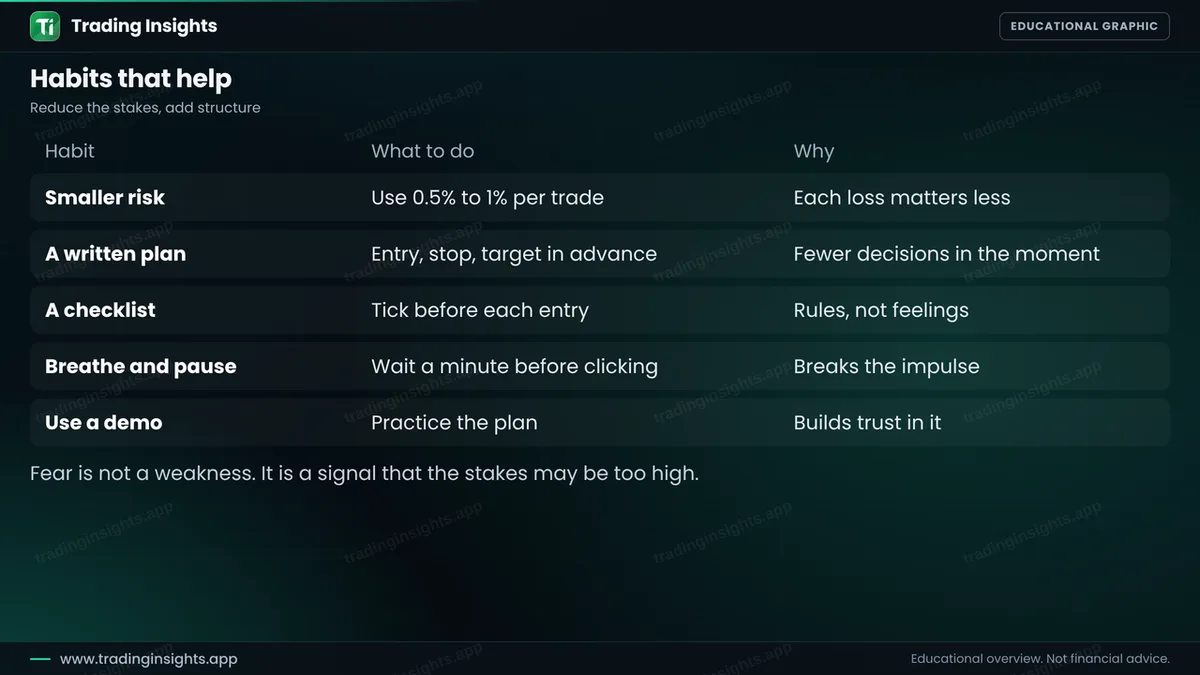
If a single loss makes your heart race, the size is probably too big. Risking 0.5% to 1% of the account makes each loss feel smaller and easier to accept. A written plan with entry, stop and target removes decisions in the moment, and a short checklist replaces feeling with rules.
Think of it as a dial. Fear is not a flaw in your character that you fix by willpower. It is a reaction to the stakes, so changing the stakes changes the reaction. Many traders find that the same strategy, taken at half the size, produces better decisions, because they can finally follow the plan.
Where this advice has limits
Cutting size lowers fear, but it does not remove the need for a strategy that works. If your rules have no edge, small losses are still losses. Very small size can also make trades feel meaningless and push you to take extra ones, which is a different problem. And if trading anxiety affects your sleep, your relationships or your health, no change in lot size is a substitute for taking a break or talking to someone qualified to help.
Illustrative example: the same trade at two sizes
A trader with a $4,800 account sells EUR/USD with a 24-pip stop and a 48-pip target. In case one, the trader risks 2.5%, which is $120. Position size is $120 / (24 pips x $10 per pip per lot) = 0.50 lot. In case two, the trader risks 0.5%, which is $24, so size is $24 / (24 pips x $10) = 0.10 lot.
Price moves 12 pips against the trade before turning. In case one, that swing is 0.50 lot x 12 pips x $10 = $60 of unrealised loss, enough to tempt a panic exit or a moved stop. In case two, the same swing is 0.10 lot x 12 pips x $10 = $12, and the trader leaves the trade alone. Price then reaches the target, and the small-size trader earns 0.10 lot x 48 pips x $10 = $48. The plan was identical. Only the stakes changed, and the stakes shaped the behaviour.
Illustrative example: when the big-size trade loses
On another day, the larger-size trader, still risking 2.5%, takes a 24-pip stop at 0.50 lot and loses 0.50 lot x 24 pips x $10 = $120. That is 2.5% in one trade. Shaken, the trader skips the next two valid setups, and one of them would have been a winner. The loss itself was within the plan, but its size changed the following decisions, which is where most of the damage from fear is done.
How to build confidence step by step
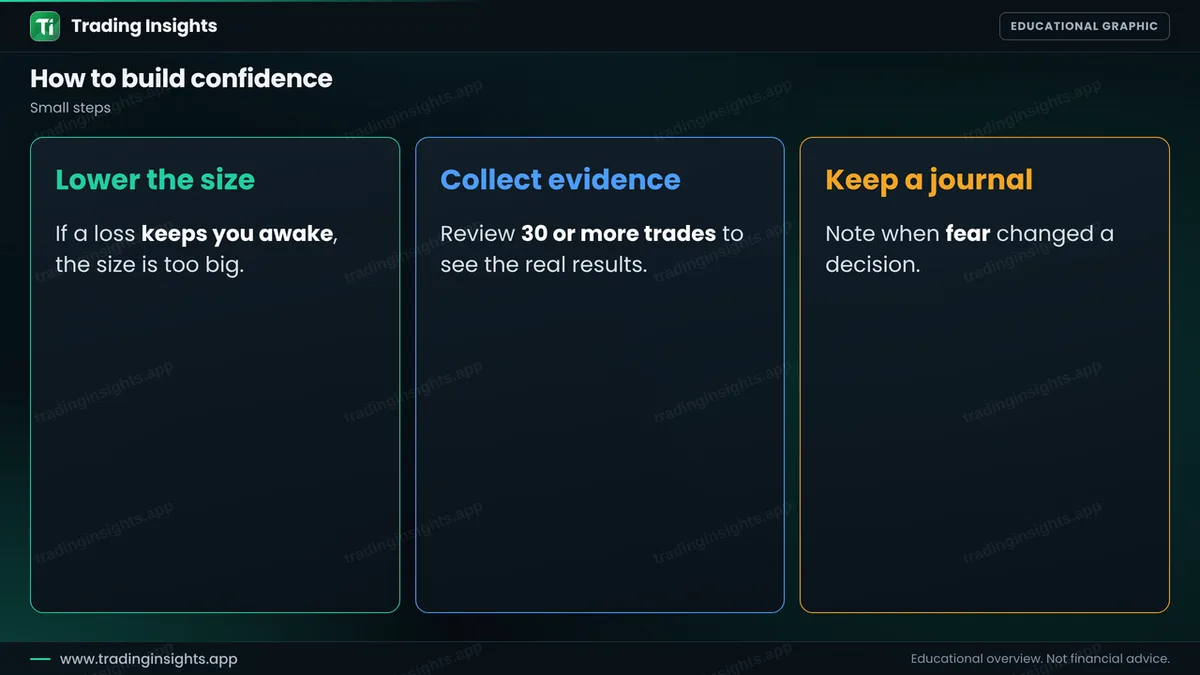
- Lower the size until a loss no longer keeps you awake. Use the position size calculator to convert your chosen percentage into lots, and the risk-reward calculator to confirm the target is worth it.
- Collect evidence. Review 30 or more trades to see your real results. Feelings about a strategy are not evidence.
- Journal your fear. Note when it changed a decision, and what the trade did next.
- Pause for a minute before clicking, and breathe slowly.
- Take a break after a rough run. A daily loss limit makes the break automatic.
What a fear journal entry can look like
You do not need to write much. After each trade, add three lines: what I planned, what I did, and what I felt. For example: "Planned to hold to the 60-pip target. Closed at plus 15 pips. Felt afraid it would reverse." After a few weeks, patterns appear, such as always exiting early after two losses. Patterns can be fixed. Vague worry cannot. Look up unfamiliar terms in the glossary if a journal template uses words you have not met.
Common mistakes
- Trying to feel no fear at all. Fear is a normal signal that money is at risk. Aim to act by your rules even when you feel it.
- Keeping the size and hoping the feeling fades. If the size is too big, the feeling will not fade. Cut the size first.
- Moving the stop away to avoid a loss. This turns a small loss into a large one. Place the stop before entry and leave it.
- Trading with money you cannot afford to lose. Rent money makes every trade frightening. Use only risk capital.
- Quitting the journal. The journal is the evidence that your fear is or is not justified. Keep it going for at least a month.
If trading causes serious stress or affects your sleep or health, take a break and consider speaking with a qualified professional.
Pre-trade checklist
- The size is small enough that a full loss will not change how I trade.
- Entry, stop and target are written down.
- I have checked that this setup follows my rules, not a hunch.
- I am not trading to recover a previous loss.
- I have taken a breath and waited at least a minute.
- I know what I will do if the trade goes against me.
Frequently asked questions
Is it normal to be scared when trading?
Yes. Money is involved, and fear is a normal response. What matters is that fear does not make your decisions.
How do I stop closing winners too early?
Use a written target, reduce the size so the swings feel safer and review your trades to see how often early exits cost you. A journal that records each early exit and what the trade did next makes the cost visible. Many traders find that the habit fades once they see the numbers.
Will a demo account remove fear?
It helps you practise the plan, but real money feels different. Move to live trading with a very small size.
What if I cannot stop worrying about losses?
Cut the size, take a break, and think about whether trading suits your situation right now. Support from a professional can help.
Your next step
Cut your risk per trade in half for the next twenty trades and write one line after each about how you felt. Compare that with how you felt at the larger size.
This is education, not financial advice. Trading carries a real risk of loss, so only use money you can afford to lose. The example numbers are illustrative.


