
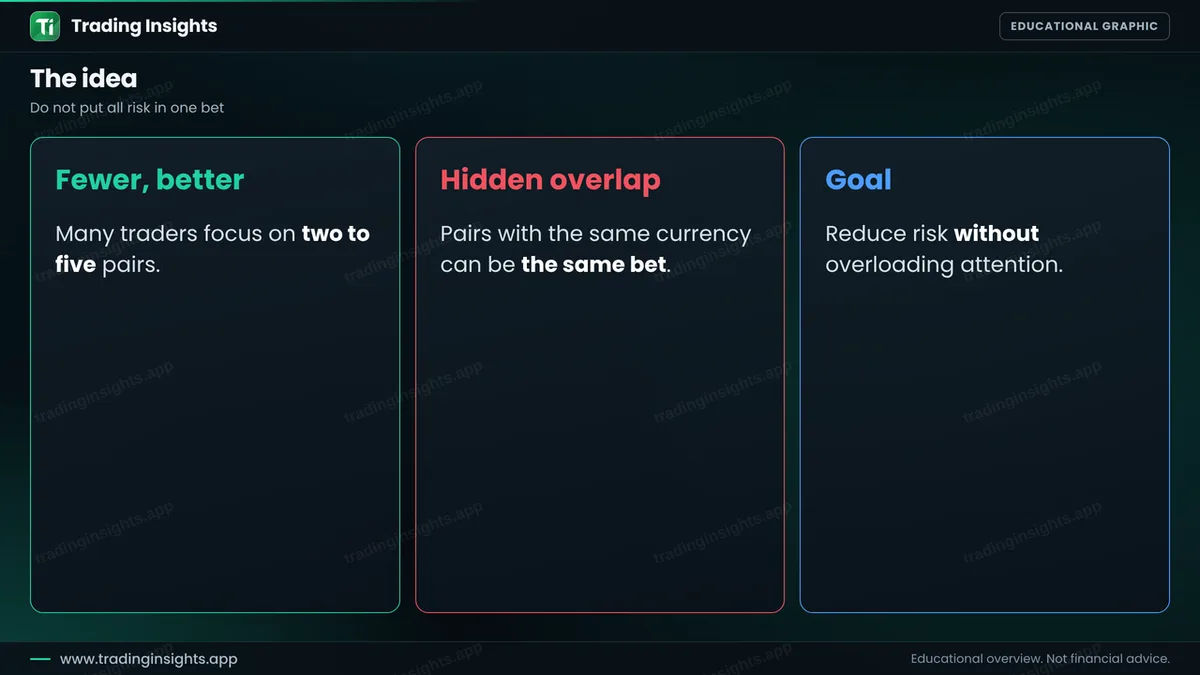
Trading more forex pairs does not make you diversified if those pairs share a currency. For most traders the practical answer is two to five pairs that they genuinely follow, with exposure counted by currency rather than by pair. Diversification means avoiding a single bet that can hurt the whole account, and in forex it is easy to hold five positions that are really one position.
How many pairs is the right number?
There is no magic figure. The limit is mostly your attention. Each pair has its own typical daily range, its own busiest sessions, its own spread, and its own set of news releases that matter. A trader who watches ten pairs usually knows each one shallowly, reacts late to news, and enters trades in a hurry. A trader who follows three pairs can learn how each behaves around the London open or a US data release, which is a real advantage.
A currency watchlist is a good way to decide. Choose pairs you can check in the time you actually have, and add a new one only when you can say what drives it.
Why several pairs can be one big bet
Every pair contains two currencies, so a pair is really two exposures at once. Buying EUR/USD means long euro and short dollar. Buying GBP/USD means long pound and short dollar. Buying AUD/USD means long Australian dollar and short dollar. Three trades, but all three lose if the US dollar rallies across the board. The pairs have different names, and the risk is the same.
The same logic works in reverse. Long EUR/USD and short USD/CHF are both bets that the dollar will weaken. Long EUR/USD and short EUR/GBP share the euro on opposite sides, so they partly cancel on the euro and leave a view on the pound versus the dollar. To see what you really hold, write the base and quote currency of every open trade and count how many times each currency appears on the long side and the short side.
Where diversification helps and where it stops
Pairs with no shared currency, such as EUR/GBP and USD/JPY, do not depend on the same central bank or the same data, so they tend to move independently most of the time. That is genuine diversification, though never complete. In a sharp risk-off event, many pairs move together because investors sell risky currencies and buy safe ones at the same time, and the links between pairs strengthen exactly when you want them to be weak. This is described in correlation breakdown in crises.
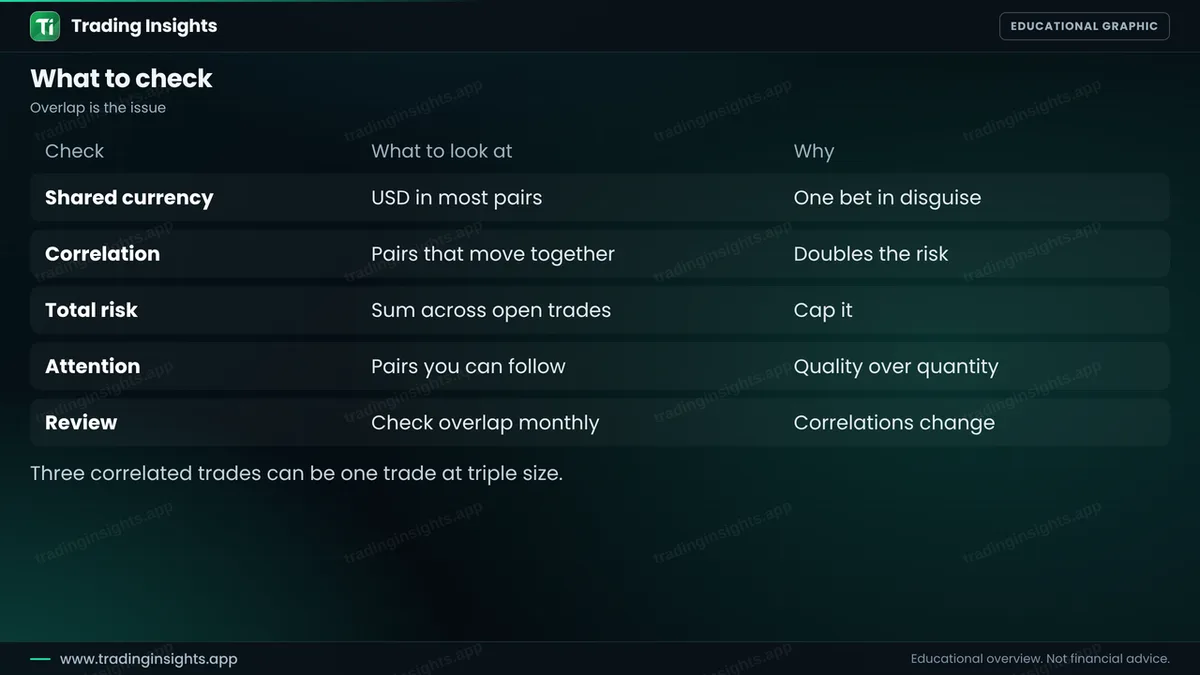
Correlations also change over time. A relationship that held for a year can weaken for months. Review the numbers monthly instead of trusting an old chart.
A practical approach, step by step
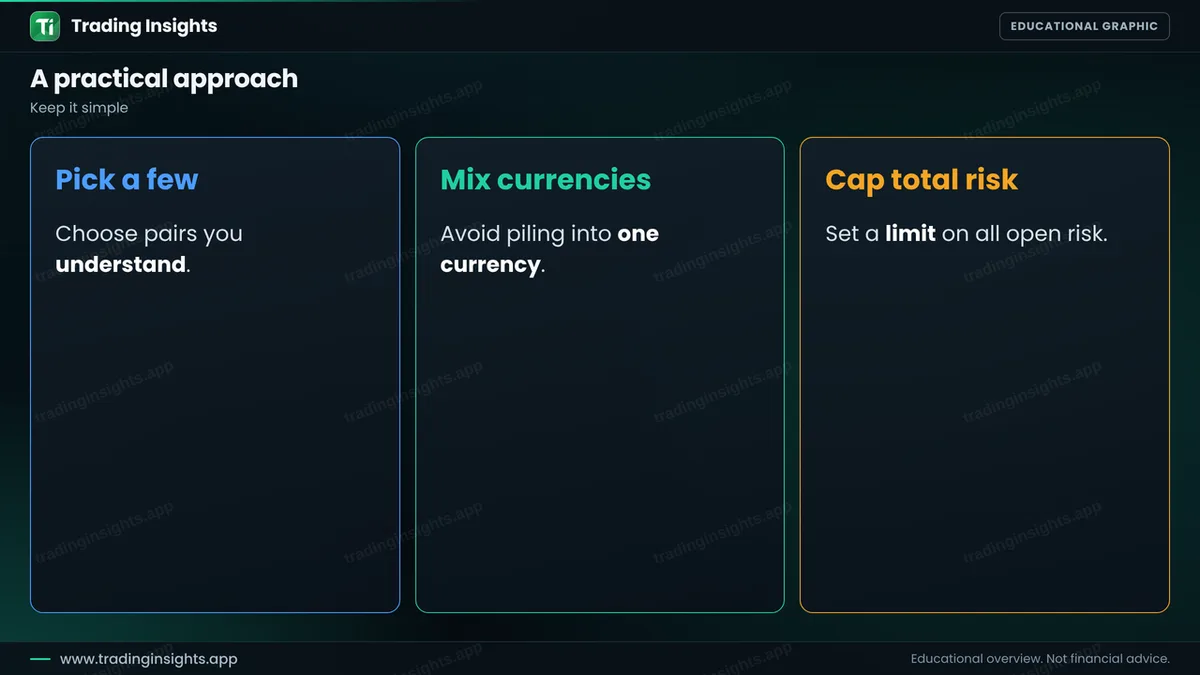
- Choose a short list. Pick two to five pairs you understand.
- List currencies, not pairs. For each open or planned trade, write the long currency and the short currency.
- Treat shared exposure as one position. If three trades are all short the dollar, size them as one idea. The guide to correlation-adjusted position sizing shows how.
- Set a cap on total open risk. Many traders choose a figure such as 2% to 3% of the account across all open trades.
- Review monthly. Note which currencies dominated your trades and whether you meant it.
Illustrative example: one idea, split correctly
This is an illustrative example, not a real trade. A trader with a $25,000 account sees the dollar weakening and likes EUR/USD, GBP/USD and AUD/USD, each with a 34-pip stop. If each trade risks 1%, the real risk is 3% of the account on one theme.
The trader sets the total risk for the theme at 1% instead. With a $25,000 account risking 1% ($250), the position size is $250 / (34 pips x $10 per pip per lot) = about 0.74 lot in total, which is about 0.25 lot in each of the three pairs. A loss across all three costs about $250 and a win of 68 pips on each would pay about $500.
In this version the dollar weakens, and all three trades reach 68 pips. The combined gain is about $500, or twice the risk. The result is the same size as taking a single trade of 0.74 lot, but the trader has spread the entry across pairs that may start moving at different times.
Illustrative example: the same trades, sized separately, go wrong
This is an illustrative example, not a real trade. Another trader with the same $25,000 account buys EUR/USD alone with a 46-pip stop. With a $25,000 account risking 1% ($250), the position size is $250 / (46 pips x $10 per pip per lot) = about 0.54 lot. Seeing no problem, the trader adds GBP/USD and AUD/USD with the same risk. A dollar rally hits all three stops. A loss of about $250 on each pair means about $750 gone, 3% of the account, from what felt like three small, separate risks.
The lesson is not that three trades are bad. It is that three correlated trades at full size made a loss three times larger than planned.
Common mistakes
- Counting pairs instead of currencies. Five pairs can hide a single currency view. Write out the base and quote of each trade before you add another.
- Taking each correlated trade at full size. This triples the real risk. Split the size or choose the best of them.
- Following more pairs than you can watch. You miss news and rush entries. Cut the list until you can check each pair every session.
- Trusting old correlation numbers. Relationships change. Re-check them every month.
- Assuming diversification removes risk. It lowers the chance that one event hurts everything at once, but a market-wide shock can still hit all your trades.
Diversification checklist
- Have I written down the long and short currency of every open trade?
- Does any one currency appear on the same side in more than one trade?
- If so, have I sized those trades as one position?
- Is total open risk below the cap I set?
- Do I know what news is due for each currency involved?
- When did I last review the correlations between my pairs?
Frequently asked questions
How many pairs should a beginner trade?
Start with one to three. It is more useful to learn how a few pairs behave than to spread attention across many. You can add more once you can describe what moves each one.
Does trading many pairs reduce risk?
Only if the pairs are driven by different currencies and events. If they share a currency or respond to the same news, you have the same risk in several forms.
How much total risk is reasonable?
Many traders cap total open risk at a few percent of the account. Pick a limit before you trade and use the position size calculator to keep each trade within it.
Do correlations stay the same?
No. They shift with interest-rate expectations, risk mood and news. Check them regularly instead of relying on one chart.
This is educational only, not financial advice. Trading carries risk of loss, and diversification reduces the chance of one bad bet but does not remove risk. The examples are hypothetical and the charts are illustrative, not real market data.


