
Seasonality in forex means a pattern that repeats at certain times of the day, week, month or year. Some of these patterns have sound reasons and are fairly consistent, mostly differences in liquidity and volatility, such as quiet Mondays, active mid-weeks and thin holidays. Claims about direction, such as a pair always rising in one month, are much weaker. None of it is dependable enough to trade blindly, so treat seasonality as an idea to test, not a signal.
What seasonality means in forex
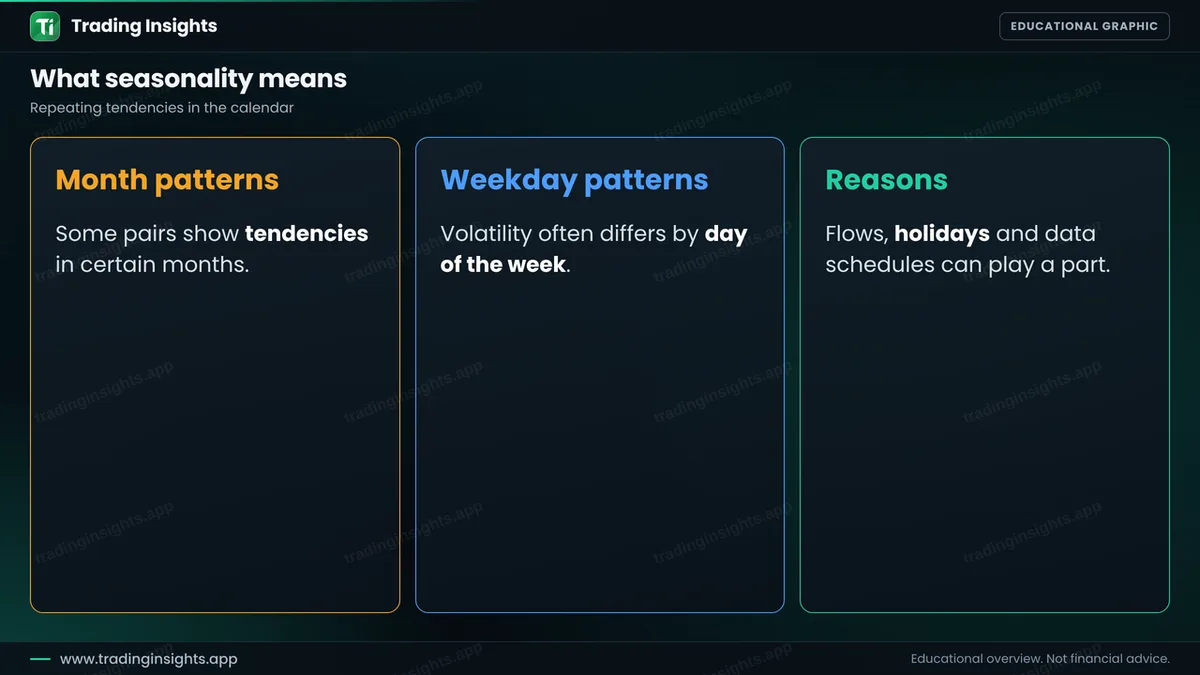
Some currency pairs have shown tendencies in certain months, and volatility often differs by day of the week. The reasons can include corporate flows, holidays, tax dates and the schedule of data releases. The pattern might not last, because once many traders know it, it can fade or flip.
Calendar effects traders watch
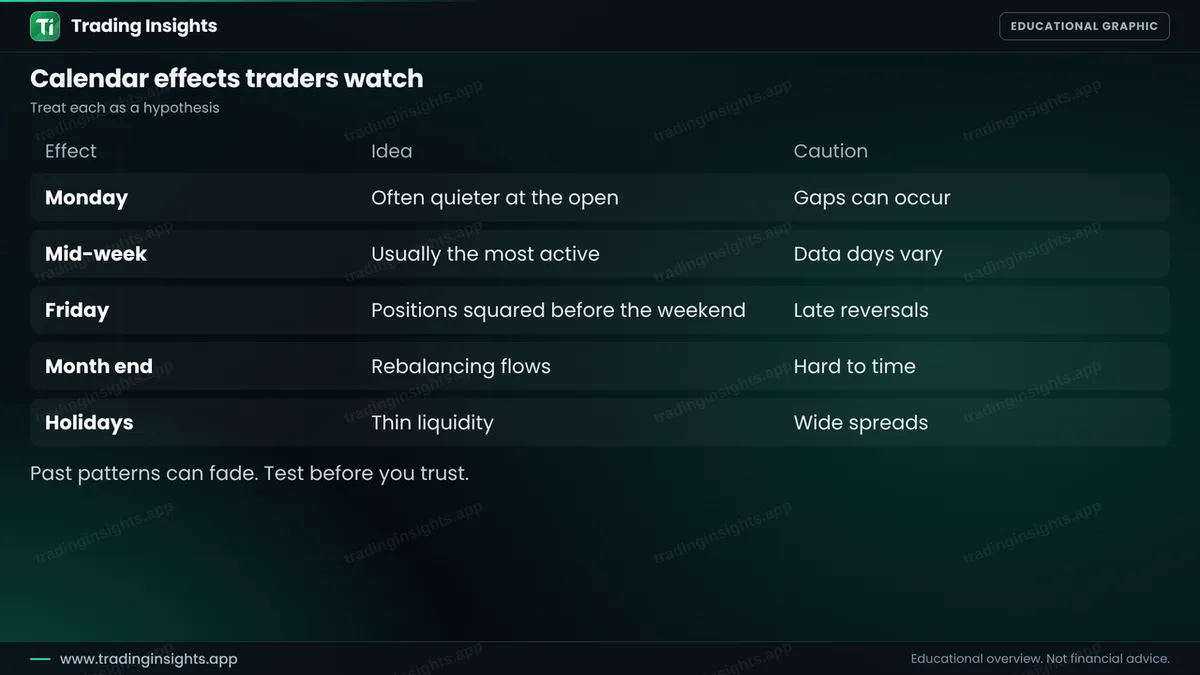
The most reliable effects relate to liquidity and volatility, not direction. Mid-week days are often more active, and Friday afternoons can see position squaring before the weekend. Holidays and the Sunday open bring thin liquidity and wider spreads. Month-end and quarter-end rebalancing by large funds is another idea, but it is hard to time and its size changes from month to month.
Why seasonal patterns can mislead
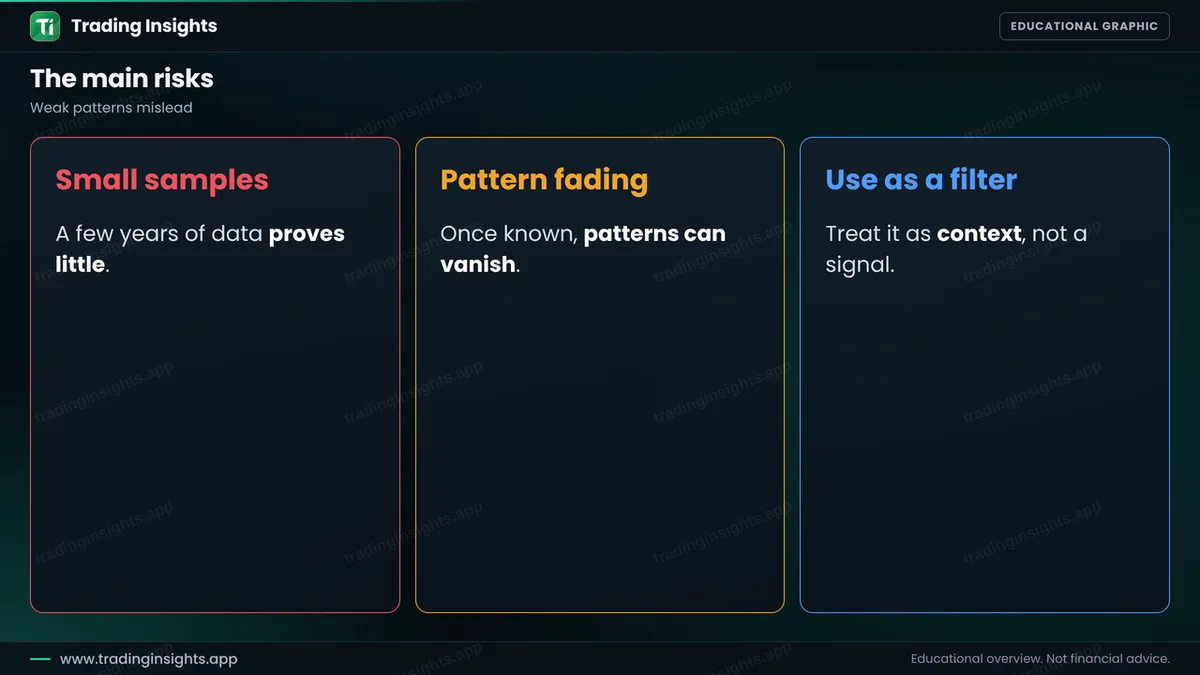
With only a few years of data, a pattern can come from luck. If you search through many months, weekdays and pairs, you will find something that looks real, simply because you looked at so many. That is data snooping. Test any pattern across many years and several pairs, include costs, and check whether it still works in recent data.
How to test a calendar idea
- Write the hypothesis in one line, such as "Failed breakouts near the Friday close often reverse."
- Define the rules before you look: entry, stop, target and which pairs.
- Collect many examples across several years and more than one pair.
- Include costs. Spread and slippage matter on thin days.
- Split the data. Check the first half and the second half separately. If the pattern vanishes in one half, be careful.
- Use it as a filter, not a trigger, for example to cut size on thin days.
- Review it every few months to see if it still holds.
Turning a calendar idea into a trade plan
A calendar idea can shape a plan, but the trade itself still needs a level and a trigger.
- Entry: a trigger candle at a marked level, on a day your test says is favourable.
- Stop-loss: beyond the swing that invalidates the idea.
- Take-profit: the first level that keeps the ratio at 2:1 or better. The risk reward calculator checks it in this calendar test.
- Position size: fixed risk over stop distance, as in the position size calculator.
Illustrative example A: a quiet-Monday range
Treat this as an illustrative example for the calendar test; it is not a real trade. The trader's tested idea is that Monday's early hours tend to stay inside the Friday range. AUD/USD drops to the bottom of that range and forms a bullish pin bar.
- Entry: buy at 0.6367
- Stop: 0.6339, 28 pips below the range
- Target: 0.6423, 56 pips above, a reward-to-risk of 1:2.0
- Account: $8,400, risking 1% = $84
Size: $84 / (28 pips x $10) = 0.30 lot. Price returns to the middle of the range and reaches the target, earning about $168. A stop-out would have cost about $84. The calendar idea only supported the plan; the level and the trigger made the entry.
Illustrative example B: a calendar idea that did not hold
Treat this as an illustrative example for the calendar test; it is not a real trade. The trader believes that this particular month is usually weak for the euro and sells EUR/USD at resistance on that basis.
- Entry: sell at 1.0848
- Stop: 1.0881, 33 pips above
- Target: 1.0782, 66 pips below
- Account: $11,500, risking 0.5% = $58
Size: $58 / (33 pips x $10) = 0.17 lot. A weak US data release pushes the euro up, the pattern fails in that year and the stop is hit for about $56. The month-based idea had been found in only a few years of data. A pattern with no clear reason and a short history is a weak foundation, and the small risk limited the cost of learning that.
What to do with the weak patterns
A weak pattern can still be useful as a reminder. If you know Sunday opens are thin, you will not chase a gap in the first minutes. If you know Friday afternoons can be choppy, you may take profits earlier or skip new trades. In both cases, the calendar changes how you behave, not what you predict. That is the safest use of seasonality: let it adjust your size and your patience, and leave the direction to your chart and your plan.
Be careful with stories that explain every pattern after the fact. If you cannot say why a tendency should exist, and you cannot find it across many years, treat it as noise.
Common mistakes
- Trading a pattern found in only a few years. Small samples are mostly luck. Test over many years and pairs.
- Using seasonality as the only reason for a trade. A date is not a setup. Wait for a level and a trigger.
- Ignoring the spread on thin days. Costs can wipe out a small edge. Check the spread first.
- Failing to recheck the pattern. Patterns fade. Review them every few months.
Pre-trade checklist
- The calendar idea is written as a one-line hypothesis.
- It has been tested over several years and more than one pair.
- Costs are included in the test.
- A level and a trigger candle are present.
- The current spread is typical for this time of day.
- The stop and target are set, with at least twice the reward.
- The lot size is derived from the stop and your fixed risk.
Frequently asked questions
Is there really seasonality in forex?
Some liquidity and volatility patterns are fairly consistent. Directional patterns are much weaker.
Which day is best to trade?
There is no single best day. Many traders find mid-week most active, but it depends on your style.
Can I trade on month-end flows?
They exist, but they are hard to time. Treat them as context.
How do I test a calendar pattern?
Backtest it across many years and pairs, include costs, and check recent performance. The glossary explains backtesting and related terms.
Learning material only, not advice. Calendar patterns often disappear once they are noticed, and the example trades use invented prices, so test any idea before trusting it.


