
The Asian session is the stretch of the trading day when Sydney and Tokyo lead the market. It is usually quieter than London or New York, so many pairs move inside narrow ranges. That suits patient range traders, but thin trading brings false breakouts, wider spreads and the cost of trading at night. The practical approach is to trade only the active pairs, keep targets inside the range, and finish before London arrives.
What the Asian session is like
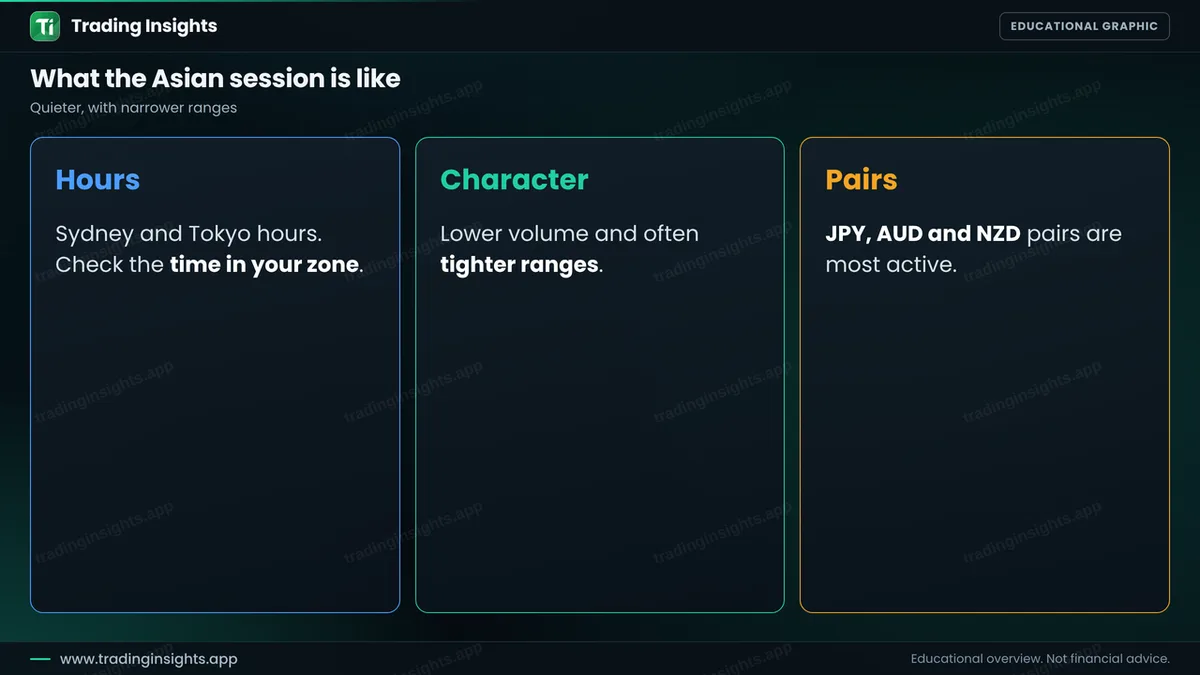
Session times shift with daylight saving, so check them in your own time zone. Volume is generally lower than during the European morning, and the most active pairs involve the yen, the Australian dollar and the New Zealand dollar. EUR/USD and GBP/USD often drift until Europe opens.
Why is it quieter? Most of the large banks and funds that move the major pairs sit in Europe and North America, and their desks are closed. With fewer orders, price tends to move between nearby levels instead of trending. That is the logic behind every rule below.
Quiet does not mean calm. A surprise from the Bank of Japan or an Australian data release can move local pairs sharply, and thin order books make those moves jumpy.
Ways to trade the Asian session
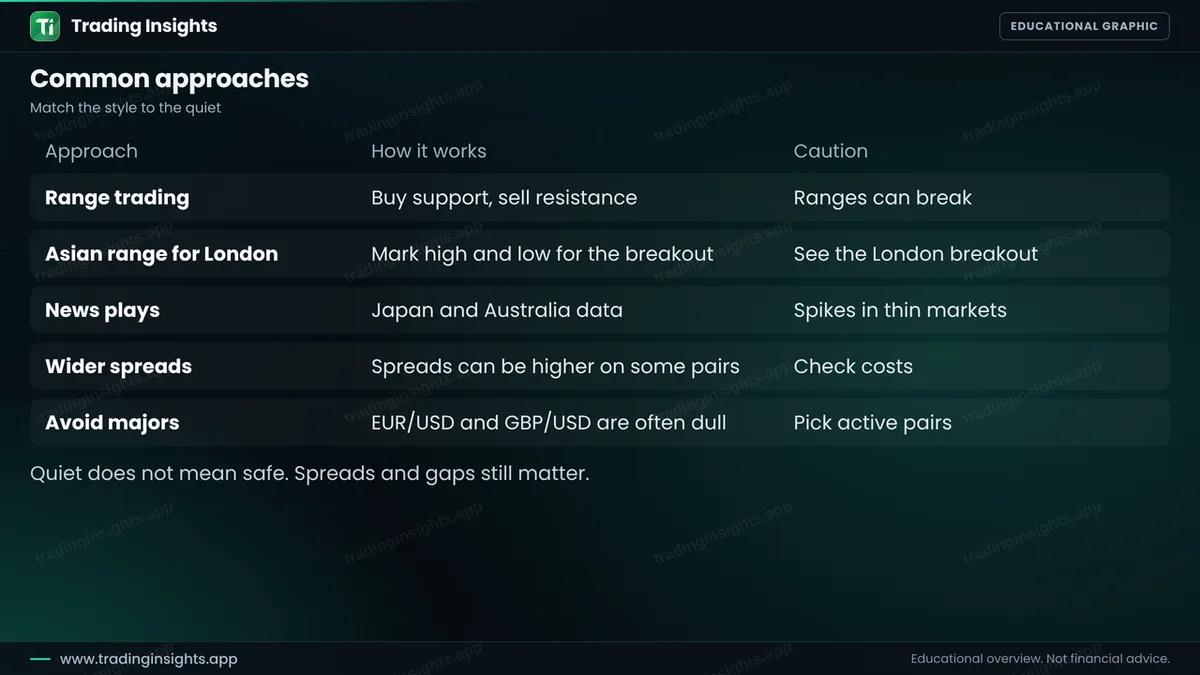
Range trading buys near support and sells near resistance while price stays inside a box. It works when the range holds and fails when it breaks, so the stop must sit outside the box and the target inside it.
Marking the range for London means noting the Asian high and low and waiting to see whether London pushes through one side. You do not have to trade during Asia at all to use it, which is the most sensible option for anyone who does not want to trade overnight.
Local news from Japan or Australia can move pairs such as USD/JPY and AUD/USD. Check the calendar before the session begins, and stand aside from range trades just before a release.
Where the range approach fails
- Before major news. A rate decision or jobs report ends a range in seconds.
- At the London open. Volume arrives and the box often breaks.
- On trend days. If price has already moved far during the session, a range may not exist; it is a slow trend.
- On wide-spread pairs. If the spread is a large share of the range, there is no room for profit.
The main risks of Asian session trading
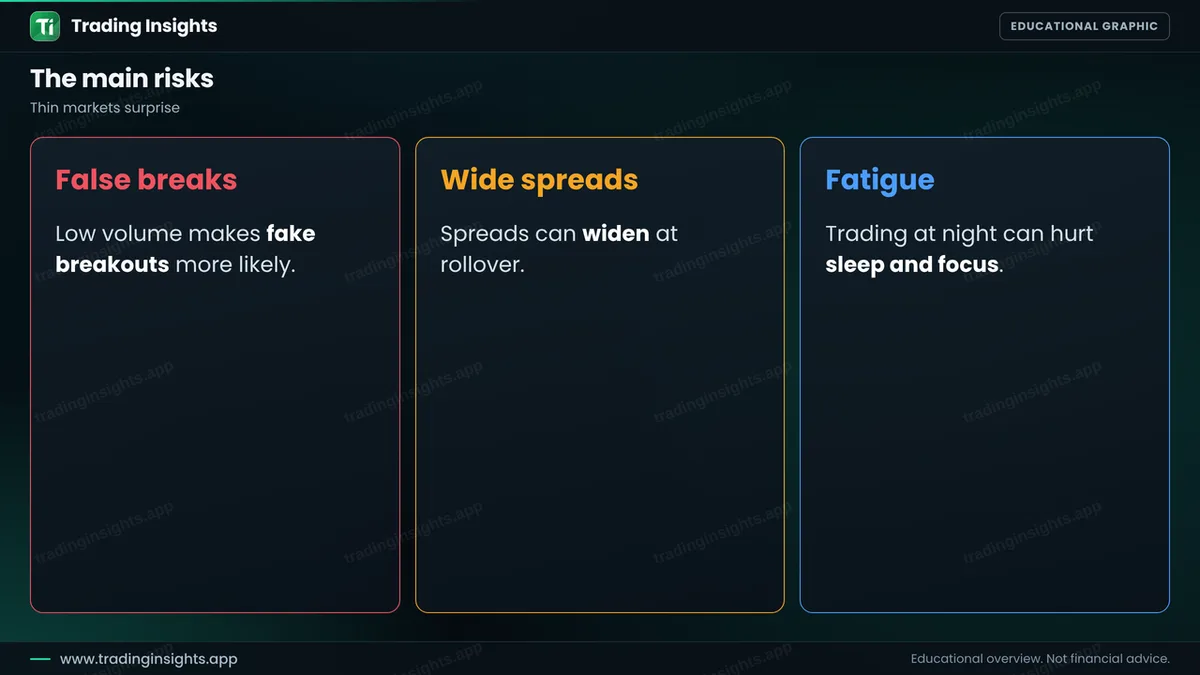
Low volume makes fake breakouts more likely, because a small order can push price through a level and then back. Spreads can also widen around the daily rollover, when many brokers reset, which raises your real cost. Compare any target with the spread before entering. Finally, trading through the night can hurt your sleep, and tired traders make more mistakes.
A simple Asian session plan
- Pick active pairs, such as USD/JPY, AUD/USD, NZD/USD or AUD/JPY.
- Mark the range using the high and low of the session so far, and only treat it as a range after price has touched both edges.
- Entry. Trade the edges after a candle closes back inside the box, not on the first touch.
- Stop-loss. Place it outside the box by a few pips beyond the extreme, so that a close outside means the range idea has failed.
- Take profit. Target the opposite side or the middle of the box, and check the reward against the risk with the risk-reward calculator.
- Position size. Risk a small fixed percentage and size from the stop distance with the position size calculator.
- Check the spread before every entry, and skip the trade if it is wide. Stop before London opens unless you plan to trade the breakout.
What to do when the range breaks
Ranges end, and the break often comes near the London open. Do not average into a losing range trade. If price closes outside the box, accept the stop. If you want to trade the break, wait for a retest of the edge and treat it as a new trade with its own stop and size.
Illustrative example: a hypothetical win fading the top of a range
This is an illustrative example with hypothetical prices, not a real trade. NZD/USD has traded between 0.5920 and 0.5985 for several hours. Price pokes to 0.5983 and the next candle closes back lower. A trader sells at 0.5978 with a stop at 0.6012, which is 34 pips away, and a target at 0.5927, which is 51 pips away, just above the bottom of the range.
With a $15,000 account risking 0.5% ($75), the position size is $75 / (34 pips x $10 per pip per lot) = about 0.22 lot. A win of 51 pips pays about $112; a loss costs about $75. Price reaches the target before Europe opens and the trade is closed.
Illustrative example: a hypothetical loss when the range breaks
This is an illustrative example with hypothetical prices. AUD/USD has ranged between 0.6540 and 0.6590. A trader sells at 0.6585 with a stop at 0.6612, which is 27 pips away, and a target at 0.6544, which is 41 pips away. A stronger-than-expected Australian data release pushes price through the top of the box and the stop is hit.
With a $15,000 account risking 0.5% ($75), the position size is $75 / (27 pips x $10 per pip per lot) = about 0.28 lot. A win of 41 pips would have paid about $115; the loss is about $75. The trader does not re-enter against the break and waits for a retest, if one comes.
Common mistakes
- Expecting big moves from a quiet session. Targets that need a trend rarely work in a range. Set targets inside the range.
- Trading dull majors with wide spreads. If the spread is a large share of the target, the trade is not worth it. Choose active pairs.
- Holding range trades into the London open. Volume arrives and ranges often break. Close or trail before London.
- Sacrificing sleep for a few small trades. Fatigue costs more than the profit. Trade a session that fits your life.
- Ignoring the calendar. A scheduled release can end a range instantly. Check it first, and see the glossary for terms you do not know.
Pre-trade checklist
- Is the pair active in this session, with an acceptable spread?
- Has price touched both edges of the range?
- Is no major news due from Japan or Australia?
- Is the stop outside the box and the target inside it?
- Is risk a small fixed percentage of the account?
- Do you plan to be flat before London opens?
Frequently asked questions
Is the Asian session good for beginners?
It can be calmer, but thin markets bring false breakouts and wider spreads. Practise on a demo account first.
Which pairs are most active in the Asian session?
Pairs with the yen, Australian dollar and New Zealand dollar, such as USD/JPY and AUD/USD.
Why do ranges often form in Asia?
Volume is lower and the big European and US markets are closed, so price often drifts between nearby levels.
How does the Asian range help London trades?
Its high and low give clear levels that the London session may break, which helps you plan entries and stops.
Your next step
For one week, mark the Asian high and low on EUR/USD or GBP/USD before London opens and note what happens in the first hour of London. Do not trade yet. Use the notes to decide whether this session suits your plan.
This is educational only, not financial advice. Trading carries risk of loss, and thin markets can cause fast losses. The examples are hypothetical, and you should only risk money you can afford to lose.


